How to Choose Commercial Coffee Machines for Your Business
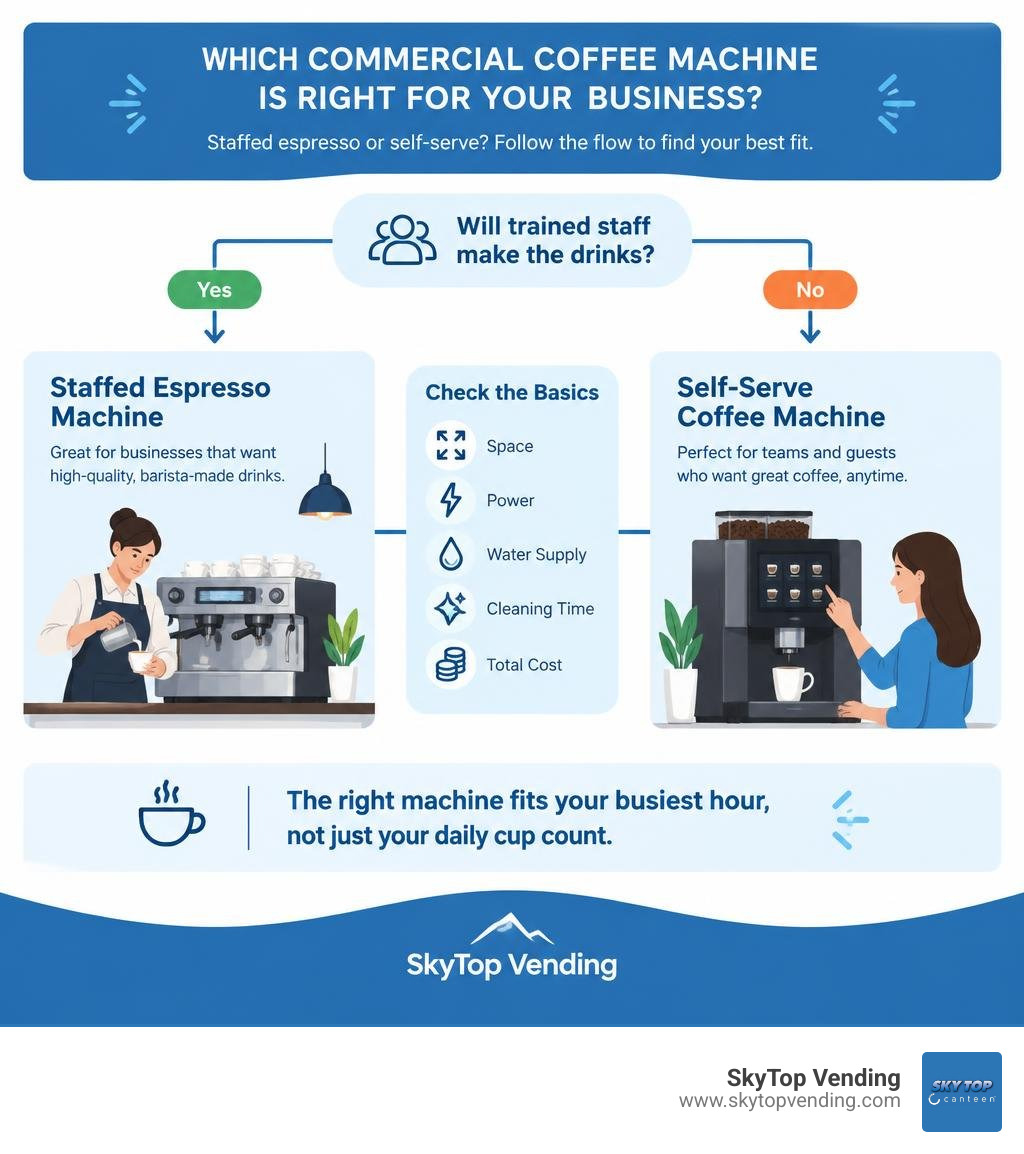
The best commercial coffee machines fit your busiest hour, not just your daily cup count. Choose a traditional espresso machine if trained staff will make drinks. Choose a self-serve bean-to-cup machine if employees or guests need coffee without a barista. For either option, check the space, power, water supply, cleaning time, and total cost before you commit.
I’m Gil Lipkin, and I’ll walk you through those trade-offs so you can find a practical fit for your workplace.
Key Types of Commercial Coffee Machines for Businesses
Navigating the equipment market can feel overwhelming because setups vary wildly in extraction method, throughput capacity, and technical complexity. Whether you manage a busy corporate campus in the Las Vegas Valley or a hospitality lounge, matching the machine configuration to your operational style ensures you avoid bottlenecks during morning rushes.
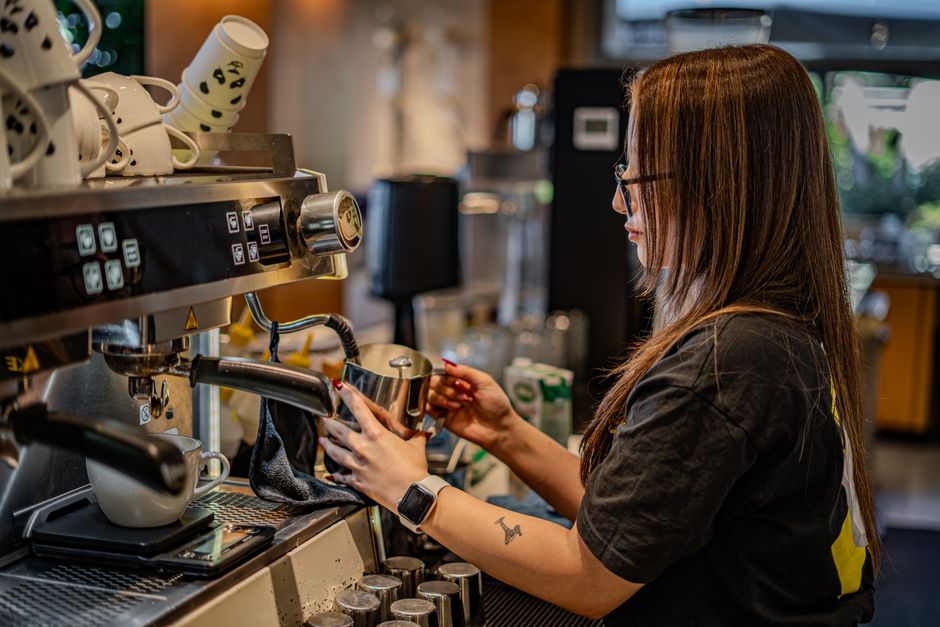
Commercial espresso machines are categorized by the number of brew groups (the metal portafilter heads where espresso extracts). More groups allow staff to extract multiple espresso shots at the same time:
- 1-Group Espresso Machines: Compact workhorses suited for low-to-moderate volume, executive suites, or boutique spaces serving 30 to 80 cups per day.
- 2-Group Espresso Machines: The commercial industry standard, capable of serving 100 to 250+ cups per day with two baristas working side by side during peak hours.
- 3-Group Espresso Machines: High-capacity systems built for continuous operation in high-traffic cafes and large venues serving 300+ cups daily.
- Bean-to-Cup Automated Systems: Push-button units with internal grinders and automated milk frothing, eliminating the need for manual barista labor.
| Machine Type | Best Suited For | Daily Volume Capacity | Price Range (Purchase) | Skill Level Needed |
|---|---|---|---|---|
| 1-Group Traditional | Small offices, boutique lobbies | 30–80 cups | $5,000 – $5,500 | Moderate to High |
| 2-Group Traditional | Mid-size cafes, bustling breakrooms | 100–250 cups | $7,200 – $15,000 | High |
| 3-Group Traditional | High-volume venues, event spaces | 250–500+ cups | $15,000 – $26,000+ | High |
| Self-Serve Bean-to-Cup | Corporate breakrooms, hospitals, campuses | 60–200+ cups | $0 upfront (placement) to $12,000+ | None (Push-button) |
If you are outfitting a full kitchen or dining hall, sourcing robust commercial restaurant coffee equipment alongside your espresso setup creates a balanced beverage station capable of handling both specialty lattes and bulk drip coffee.
Single-Group vs. Multi-Group Espresso Systems
The primary operational difference between a single-group and multi-group setup is concurrent workflow. A 1-group machine like the Rocket Boxer 1 Alto delivers commercial-grade steam pressure and precise temperature stability, but it restricts you to pulling one double shot at a time.
When your volume climbs, a 2-group platform like the Sanremo Zoe or Rocket RE Doppia doubles extraction throughput. Multi-group models often incorporate advanced quality-control electronics:
- Integrated Shot Timers: Displays real-time extraction duration on each group head, alerting the operator if the grind size is drifting off target.
- Built-in Volumetric Scales: Measures the liquid espresso yield directly in the cup, automatically cutting off the shot at your exact recipe target.
- Dual Steam Wands: Allows two operators to steam whole milk, oat milk, or almond milk simultaneously without pressure drop-offs.
High-End Commercial Espresso Brands: La Marzocco, Sanremo, and Rocket
For venues requiring uncompromised build quality, temperature repeatability, and design prestige, three Italian heritage manufacturers dominate the landscape:
- La Marzocco: Renowned for dual-boiler engineering and saturated brew groups. Models like the Linea Classic and Linea PB ($20,780 to $25,690+) represent the benchmark in durability, holding resale value and running uninterrupted under relentless daily demand.
- Sanremo: A leader in design ergonomics and temperature profiling. From the reliable entry-level Sanremo Zoe and D8 up to the high-performance Sanremo F18 MB and Cafe Racer, these machines offer independent multi-boiler management for precision extraction across single-origin roasts.
- Rocket Espresso: Known for blending classic aesthetics with compact commercial durability. Models like the Boxer and RE Doppia provide commercial reliability, making them favorites for boutique offices and medium-volume venues looking for Italian engineering at accessible price points ($5,000 to $9,000).
Traditional Espresso vs. Automated Bean-to-Cup Systems
The decision between a traditional espresso station and an automated system hinges on one central question: Who is making the coffee?
Traditional espresso machines require trained baristas who understand grind calibration, tamping pressure, extraction yields, and milk texturing. Bean-to-cup systems automate the entire sequence inside a self-contained cabinet. At SkyTop Vending, we deliver comprehensive business coffee solutions tailored around your staffing model, ensuring your team gets craft-quality drinks without unnecessary labor overhead.
Choosing Commercial Coffee Machines: Traditional Espresso vs. Bean-to-Cup
When comparing these two formats, consider how labor, speed, and waste impact your day-to-day operations:
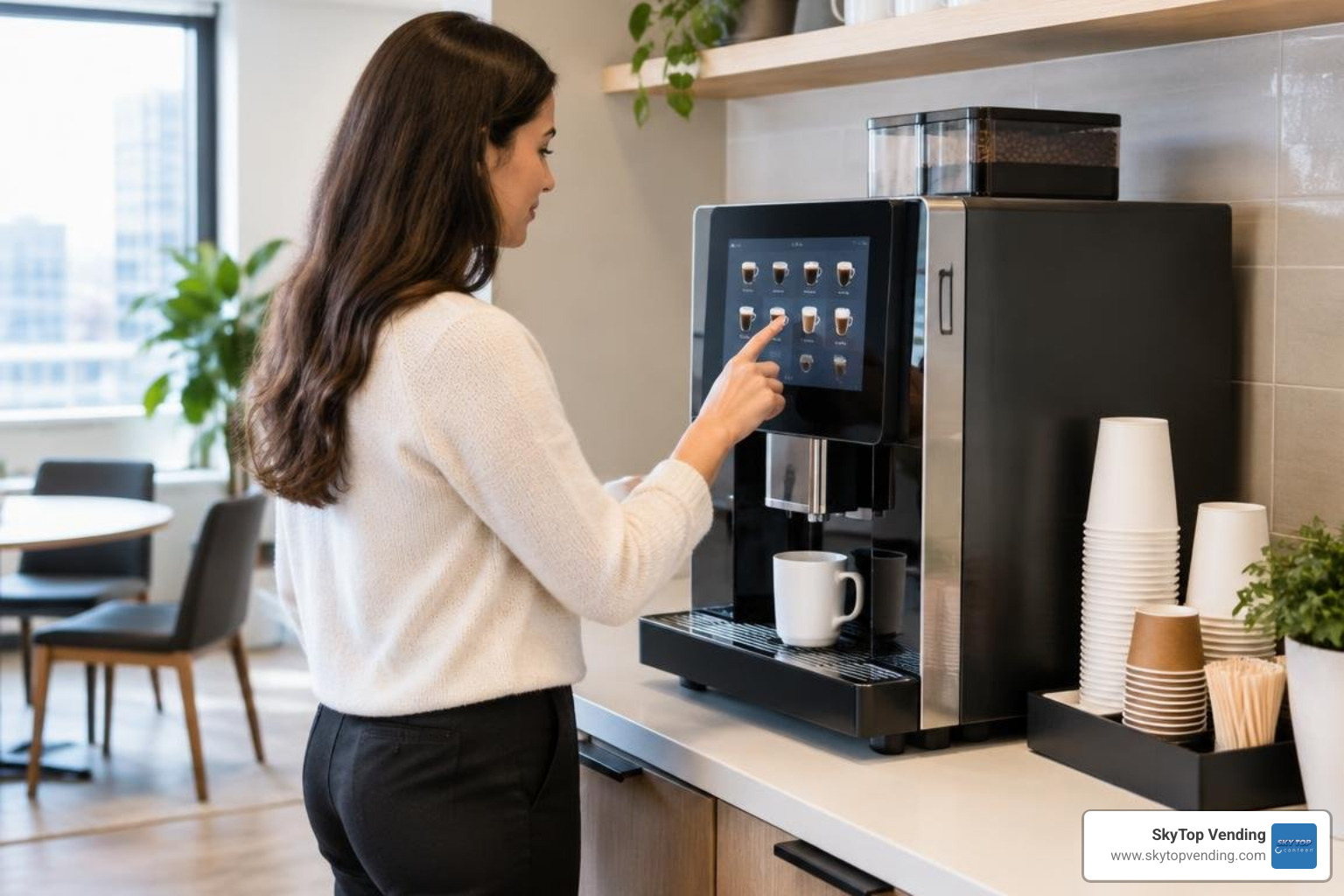
In self-serve environments like healthcare lobbies, universities, and busy office breakrooms, an automated bean-to-cup system keeps foot traffic moving smoothly by brewing lattes, cappuccinos, and Americanos at the touch of a screen.
Self-Serve Innovation and Zero-Upfront Payment Models
Automated coffee stations have advanced beyond standard vending hardware. Solutions like the NESCAFÉ Self-Serve Bean to Cup Coffee Machine combine high-definition 10-inch touchscreens with integrated payment processing and eco-friendly furniture bases made from recycled materials.
Modern bean-to-cup systems frequently offer flexible financial programs that eliminate capital expenditure:
- Revenue-Share Models: Qualified locations receive the commercial machine, base unit, delivery, and routine servicing with zero upfront investment. The hardware operator stocks ingredients and maintains equipment, sharing drink sale profits with the venue (often generating thousands in annual passive revenue).
- Pay-Per-Drink Subsidies: Businesses can set employee pricing (e.g., subsidized $1.00 lattes or complimentary beverages tracked via staff badges).
- Powdered Milk vs. Fresh Milk Systems: While fresh milk delivers authentic microfoam, specialized milk powder systems eliminate daily milk line souring, cut cleaning labor down to under five minutes, and prevent cross-contamination.
Technical Specifications and Site Requirements
Installing a commercial coffee maker requires proper utility planning. Failing to verify voltage or water filtration ahead of time can cause costly project delays.
Power, Water Filtration, and Dimension Planning
Before ordering commercial coffee equipment, audit your physical installation site against these three requirements:
- Electrical Power: High-volume commercial machines feature large heating elements to recover steam pressure instantly. While compact single-group units may operate on standard 120V / 20A dedicated circuits, multi-group espresso machines and rapid-brew bean-to-cup systems generally require dedicated 208V to 240V single-phase lines drawing 20 to 30 amps.
- Plumbing & Direct Water Lines: Commercial machines require direct water hookups (typically 3/8-inch cold water lines with shut-off valves) delivering consistent water pressure between 30 and 50 PSI. Direct countertop drainage is also necessary to handle rinse cycles and drip-tray runoff.
- Water Filtration (Critical for Scale Prevention): In hard-water regions like Southern Nevada, untreated municipal water will ruin commercial boilers with limescale within months. Install multi-stage reverse osmosis (RO) systems with mineral remineralization or dedicated commercial scale-inhibiting water filters.
- Dimensions & Counter Clearance: Ensure you have adequate depth (typically 20 to 24 inches) and counter clearance. If your machine sits below overhead cabinets, account for bean hopper lids opening upwards. Leave 3 to 4 inches of rear clearance for proper heat ventilation.
Maintenance Protocols and Operational Costs
Routine maintenance protects your beverage quality and prevents emergency service calls. Following our office coffee machine maintenance guide establishes clear daily, weekly, and quarterly responsibilities:
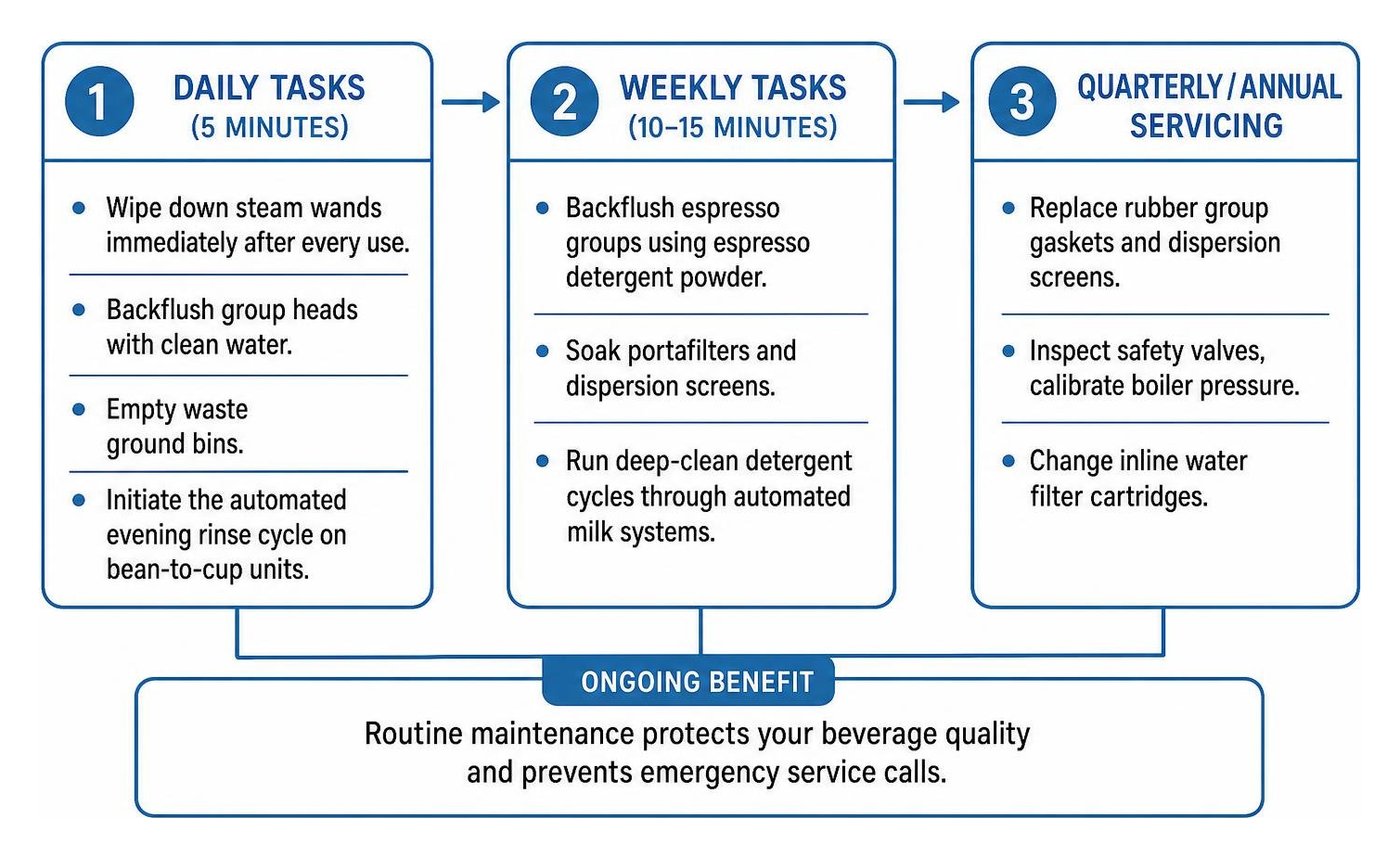
- Daily Tasks (5 Minutes): Wipe down steam wands immediately after every use. Backflush group heads with clean water, empty waste ground bins, and initiate the automated evening rinse cycle on bean-to-cup units.
- Weekly Tasks (10 to 15 Minutes): Backflush espresso groups using espresso detergent powder. Soak portafilters and dispersion screens. Run deep-clean detergent cycles through automated milk systems.
- Quarterly/Annual Servicing: Replace rubber group gaskets and dispersion screens. Inspect safety valves, calibrate boiler pressure, and change inline water filter cartridges.
Financial Evaluation and Sustainability Considerations
Investing in premium coffee equipment pays dividends in workplace satisfaction, client hospitality, and retail revenue. When evaluating your program, weigh the equipment’s total cost of ownership against its daily productivity gains. Exploring options for upgrading office coffee amenities helps keep your staff on-site and energized throughout the workday.
Evaluating ROI and Revenue on Commercial Coffee Machines
To calculate the financial return on a commercial coffee setup, evaluate your estimated volume, ingredient cost per serving, and drink sale price:
- Cost Per Serving: A specialty bean-to-cup latte (including espresso beans, milk powder or fresh milk, cup, and compostable lid) typically costs between $0.35 and $0.65 to produce.
- Retail / Subsidized Pricing: Selling drinks at a workplace rate of $2.50 yields an operating profit margin exceeding 70% per cup.
- Daily Volume Benchmarks: Serving just 35 to 50 cups per day can yield thousands of dollars in net annual profit or fully offset equipment lease payments.
When balancing your balance sheet, weigh renting vs buying coffee equipment to decide whether outright capital depreciation or a fully managed rental agreement fits your tax and cash flow strategy.
Eco-Friendly Features and Energy-Saving Technologies
Modern commercial coffee machines incorporate advanced green technologies that lower operating costs while supporting corporate sustainability initiatives:
- Induction Boiler Heating (e.g., Varitherm): Heats water instantaneously on demand rather than keeping large water volumes constantly boiling, reducing idle energy consumption by up to 60%.
- Intelligent Standby / Eco Modes: Automatically drops boiler temperatures during off-peak hours, evenings, and weekends, quickly returning to operating temperature when a user approaches.
- Sustainable Consumables & Recycled Furniture: Modern self-serve kiosks feature modular housing made from 100% recycled plastics, paired with plant-based fiber lids and recyclable paper takeaway cups.
Frequently Asked Questions About Commercial Coffee Machines
What is the price range for commercial espresso equipment?
Entry-level commercial 1-group machines start around $5,000 to $5,500. Workhorse 2-group machines range between $7,200 and $15,000, while premium 3-group units from manufacturers like La Marzocco or Sanremo range from $20,000 to over $26,000. Automated bean-to-cup machines range from $3,000 for light-duty tabletop units to $12,000+ for high-traffic touch-screen kiosks (or $0 upfront under revenue-share placement agreements).
How much daily cleaning does a bean-to-cup machine require?
Modern automated machines require very little hands-on labor. Daily automated rinse cycles take less than 5 minutes, primarily involving emptying the internal coffee ground bin and wiping down external surfaces. Weekly deep cleans require about 10 to 15 minutes to run manufacturer-approved cleaning tablets through the brewing chamber and milk channels.
Which commercial coffee machine is best for high-traffic environments?
For self-serve venues serving 80 to 200+ drinks per day without dedicated staff, automated bean-to-cup systems with direct water lines, dual bean hoppers, and internal milk powder canisters provide the highest reliability and speed. For staffed cafes or catering operations where visual craft is key, a 2-group or 3-group volumetric commercial espresso machine is the industry standard.
Conclusion
Choosing the right commercial coffee equipment comes down to matching machine capacity, labor availability, and utility readiness to your daily beverage volume. Whether you need a multi-group Italian espresso powerhouse for a dedicated barista station or an automated, touchless bean-to-cup kiosk for your breakroom, prioritizing reliable engineering and proactive maintenance ensures smooth daily service.
Since 1977, SkyTop Vending has provided business breakroom solutions across the Las Vegas Valley. With our “Service the way YOU like it” approach and a 99.4% client retention rate, we manage every detail—from equipment selection and water filtration to scheduled stocking and preventative repairs.
Explore our curated guide to the top commercial coffee machines for business needs to find the ideal coffee program for your workplace today.