Understanding Commercial Machine Types and Brewing Technologies
Every commercial coffee program balances craft, speed, and labor. When building out a coffee program, the machine you choose determines how your baristas work, how long customers wait, and how consistent every cup tastes across different shifts. If you are preparing to buy a coffee machine for a cafe, understanding the core equipment categories will help you match the hardware to your menu and staffing model.
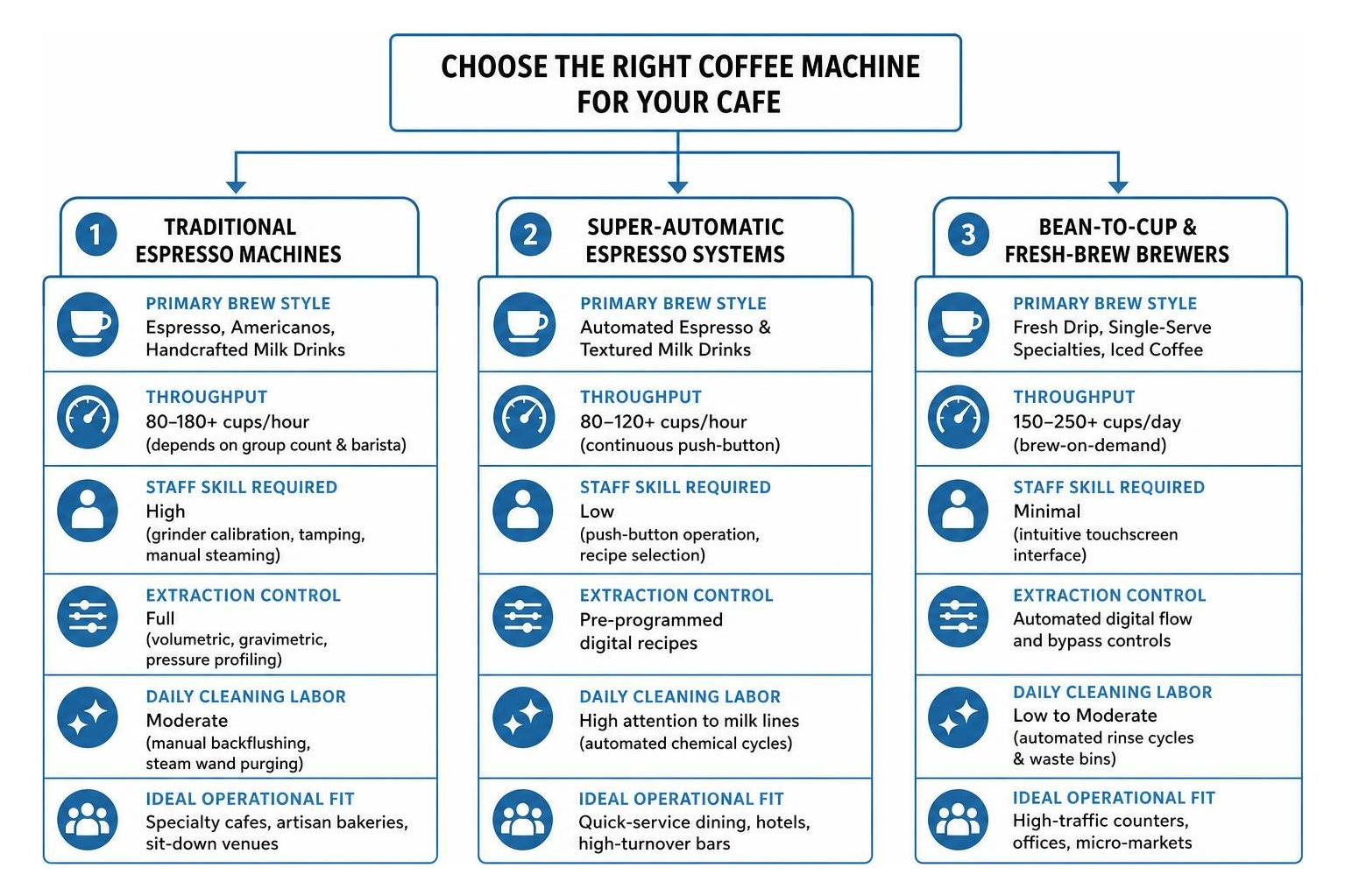
Commercial brewing hardware generally falls into three categories:
- Traditional Commercial Espresso Machines: Require manual dosing, tamping, and milk steaming. They offer unmatched control over extraction parameters and provide the classic theater of an artisan coffee shop.
- Super-Automatic Espresso Machines: Handle grinding, tamping, extraction, and milk texturing with the push of a button. They eliminate operator error and speed up service.
- Fresh-Brew and Bean-to-Cup Systems: Grind whole beans on demand to brew single cups of specialty drip, iced coffee, or specialty drinks through automated internal filter or press chambers.
| Feature / Metric | Traditional Espresso Machines | Super-Automatic Espresso Systems | Bean-to-Cup & Fresh-Brew Brewers |
|---|---|---|---|
| Primary Brew Style | Espresso, Americanos, Handcrafted Milk Drinks | Automated Espresso & Textured Milk Drinks | Fresh Drip, Single-Serve Specialties, Iced Coffee |
| Typical Throughput | 80–180+ cups/hour (depends on group count & barista) | 80–120+ cups/hour (continuous push-button) | 150–250+ cups/day (brew-on-demand) |
| Staff Skill Required | High (grinder calibration, tamping, manual steaming) | Low (push-button operation, recipe selection) | Minimal (intuitive touchscreen interface) |
| Extraction Control | Full (volumetric, gravimetric, pressure profiling) | Pre-programmed digital recipes | Automated digital flow and bypass controls |
| Daily Cleaning Labor | Moderate (manual backflushing, steam wand purging) | High attention to milk lines (automated chemical cycles) | Low to Moderate (automated rinse cycles & waste bins) |
| Ideal Operational Fit | Specialty cafes, artisan bakeries, sit-down venues | Quick-service dining, hotels, high-turnover bars | High-traffic counters, offices, micro-markets |
Traditional vs. Super-Automatic: Which to Choose When You Buy a Coffee Machine for Your Cafe
The choice between traditional and super-automatic systems often hinges on your staffing strategy and brand identity.
Traditional multi-group espresso machines are the gold standard for specialty coffee shops. Units engineered with independent group boilers, robust saturated group heads, and dedicated steam reservoirs allow baristas to dial in fine grind adjustments and steam silky microfoam for custom latte art. However, traditional machines demand extensive barista training. If your team turns over frequently, maintaining consistent extraction quality across morning and afternoon shifts becomes an ongoing challenge. Pairing your setup with tailored business coffee solutions helps bridge these gaps with reliable ongoing support and equipment planning.
Super-automatic machines remove human variance by housing internal precision grinders, automated mechanical tamping pistons, and integrated milk delivery systems. Units like the Astra SM-222-1-GLB Super Mega can produce up to 120 cups per hour using a 4.2-liter boiler and dual built-in hoppers. With programmable touchscreen menus, any team member can produce a consistent cappuccino in seconds. The tradeoff is creative flexibility: you sacrifice the visual craft of manual pulling, and internal milk plumbing requires strict, non-negotiable sanitizing routines to prevent clogs.
Fresh-Brew and Bean-to-Cup Systems for High-Efficiency Workflows
If your business caters to on-the-go customers who want premium drip or iced beverages alongside specialty lattes, bean-to-cup systems offer an efficient, low-waste alternative to traditional batch brewers.
Traditional large batch airpots often lead to discarded coffee during slow hours. Modern bean-to-cup machines solve this by grinding and extracting coffee only when ordered. For example, commercial brew-on-demand technology found in systems like the Franke A800 Fresh Brew can deliver up to 250 cups per day across multiple bean varieties. These units use advanced real-time flow adjustments and cold-water bypass features to brew authentic iced coffee instantly without ice melt dilution.
Similarly, single-serve bean-to-cup models like the Keurig Eccellenza Touch brew over 150 cups per day using reverse French press mechanics and stainless-steel mesh filters. These setups give guests and staff access to up to 10 distinct specialty beverages with minimal prep work.
Key Factors When You Buy a Coffee Machine for a Cafe

Selecting commercial brewing equipment requires a close look at how engineering details translate to your daily counter workflow.
Sizing and Daily Capacity: Matching Machine Volume to Peak Demand
To properly size your machine, focus on your peak 60-minute service window rather than total daily cup estimates. A cafe that sells 300 drinks evenly across eight hours faces completely different thermal demands than a venue that sells 200 of those drinks between 7:30 AM and 8:30 AM.
When planning to buy a coffee machine for cafe operations, group head configuration and boiler volume dictate how quickly your team can clear drink tickets:
- Single-Group Machines (1.3L to 4L Boilers): Best suited for boutique bakeries, low-volume dessert shops, or secondary decaf stations serving under 40 drinks per hour.
- 2-Group Machines (10L to 13L Total Boiler Capacity): The standard workhorse for mid-sized cafes. A dual-group unit allows two portafilters to pull simultaneously while supporting continuous milk steaming for 80 to 120 cups per hour.
- 3-Group Machines (14L to 19L+ Boilers): Essential for high-volume urban locations where multiple baristas work the counter together, pushing out 150 to 200+ espresso drinks per hour without boiler recovery lag.
Balancing these machine specs with quality roasts is crucial for long-term operational success; explore brewing success and finding the best coffee for businesses to refine your beverage standards.
Advanced Consistency: Weight-Based Dosing and Pressure Profiling
In high-volume commercial environments, extraction consistency makes or breaks customer loyalty. Modern equipment uses gravimetric sensors and digital pressure profiling to remove guesswork.
State-of-the-art machines like the La Marzocco Strada X (AV) incorporate mass-based profiling and predictive algorithms. Rather than relying on simple flowmeters that measure water entering the group, built-in scales measure the liquid espresso entering the cup in real time. Combined with Smart Saturation—which automates pre-infusion based on backpressure sensed at the puck—these systems ensure every shot hits its exact target weight regardless of minor barista dosing variances.
Pairing your espresso machine with a grind-by-weight grinder creates a closed-loop consistency system. The Rocket Doppia DE and Fiorenzato F64 EVO PRO Sense bundle pairs a 13-liter dual-boiler machine (4L steam + 9L dedicated brew) with 64 mm flat titanium burrs. The grinder senses portafilter weight directly, preventing dosing drift as burrs heat up during morning rushes.
Technical Specifications, Utilities, and Maintenance Planning
Commercial coffee machines require precise utility preparation. Overlooking plumbing, voltage, or spatial constraints during counter buildout can lead to expensive delays.
Water Filtration and Preventive Maintenance Protocols
Water quality is the single biggest factor in machine reliability and beverage taste. Commercial boilers operate at high temperatures, turning dissolved calcium and magnesium minerals into hard scale. Scale coats heating elements, blocks flow restrictors, and causes temperature sensors to misread.
Most commercial manufacturers—including Astra and Rocket—explicitly exclude scale-related damage from their standard warranties. In hard water areas like the Las Vegas Valley, dedicated multi-stage filtration or reverse osmosis systems with mineral remineralization are essential.
Daily and weekly maintenance protocols must be built directly into staff opening and closing checklists:
- Daily: Chemical backflushing of group heads, purging and wiping steam wands with dedicated sanitizing solutions, and emptying internal grounds bins.
- Weekly: Soaking portafilters and dispersion screens in warm detergent baths, checking grinder burrs for fines buildup.
- Quarterly: Testing line water hardness, swapping carbon water filter cartridges, and inspecting group head gaskets.
Total Cost of Ownership and Layout Integration
The sticker price of a commercial coffee machine accounts for only part of your total investment. Factoring in counter ergonomics, utility buildouts, and recurring service agreements provides a realistic view of your long-term budget.
When designing your service counter, consider the unit’s physical footprint. A commercial 2-group machine like the La Marzocco Strada X measures 83 cm (32.7 inches) wide and weighs 94 kg (207 lbs) dry. You must ensure the service counter can support this weight while leaving enough clearance for knocking boxes, grinders, pitcher rinsers, and order staging. For businesses evaluating cash flow strategies, reviewing our rent or buy commercial equipment analysis helps clarify capital expense versus full-service lease options.
Frequently Asked Questions About Commercial Cafe Coffee Equipment
What electrical and plumbing requirements are needed for commercial cafe espresso machines?
Most commercial 2-group and 3-group espresso machines require a dedicated single-phase 208V–240V electrical connection on a 30-amp to 50-amp breaker to power high-wattage heating elements (ranging from 4,000W to 6,000W+). Plumbing requires a cold water line delivering 45 to 65 PSI through a 3/8-inch dedicated shutoff valve, protected by backflow preventers and commercial filtration. A heat-resistant, reinforced gravity drain hose running directly to an open floor sink or hub drain is also required. Ensure all equipment carries NSF sanitation and ETL/UL safety certifications to satisfy local health and building codes.
How do dual boilers improve espresso consistency during morning rush hours?
Single-boiler heat-exchanger machines rely on a single water source for both high-pressure steaming and brewing water, which can cause temperature fluctuations during continuous service. Dual-boiler machines use separate, independently heated reservoirs: a large, high-pressure steam boiler and dedicated brew boilers managed by digital PID controllers. This design prevents thermal drops at the group head, allowing baristas to pull back-to-back shots while steaming milk continuously with zero loss of pressure or extraction stability.
How often should a commercial cafe coffee machine be cleaned and descaled?
Group heads and portafilters should be backflushed with approved espresso detergent at the end of every business day. Super-automatic milk lines and steam wands must be purged and chemically flushed daily to prevent milk stone buildup and bacterial growth. Full system descaling should only be performed by certified service technicians, as routine operational descaling can damage sensitive internal solenoid valves. Preventing scale via proactive water filter cartridge replacement every 3 to 6 months is the safest way to maintain your equipment.
Conclusion
Choosing the right commercial coffee machine means matching your menu vision with peak-hour speed, staff capabilities, and long-term utility planning. Whether you opt for a handcrafted traditional multi-group setup or an automated fresh-brew system, investing in reliable commercial hardware and proactive water treatment protects your business from costly downtime.
Here in the Las Vegas Valley, SkyTop Vending has delivered customized breakroom and beverage solutions backed by our signature commitment: “Service the way YOU like it.” Since 1977, our tailored equipment strategies and responsive service have earned us a 99.4% client retention rate across southern Nevada businesses.
Ready to build out a dependable, high-performing beverage station? Contact our local specialists today and explore top commercial coffee machines for every business need.