Are Tobacco Vending Machines Legal? Start With Age-Restricted Access
Yes, tobacco vending machines can be legal in the United States, but federal rules generally limit them to facilities where no one under 21 is allowed. A machine in a public lobby, all-ages restaurant, or open break room is usually not a compliant option.
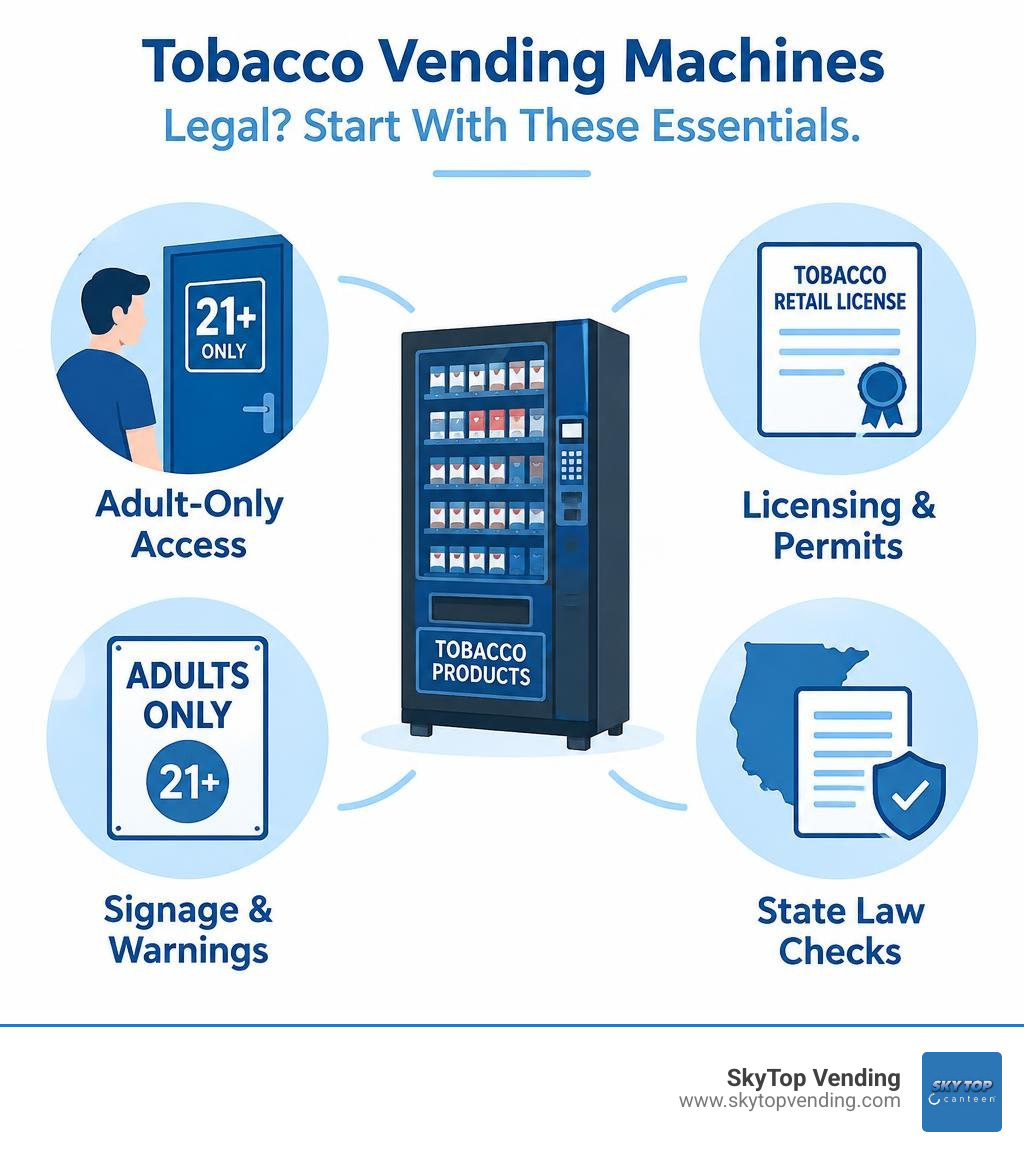
Before placing a cigarette machine, confirm these basics:
- The machine will be in a truly adult-only area.
- Your state and city allow the machine at that location.
- You have the required tobacco retail license, permits, warning signs, and records.
- The machine’s products and age-access controls meet applicable rules.
Federal law is only the starting point. States can add tighter placement rules, separate licensing for every machine, specific sign wording, distance rules near entrances, and fines for violations. For example, a compliant adult-only bar setup may still need a state license and visible age-warning notice.
I’m Gil Lipkin, and this guide will help you understand the age-verification and placement rules to check before adding a cigarette vending machine to your facility.
Easy are tobacco vending machines legal word list:
Are Tobacco Vending Machines Legal in the United States?
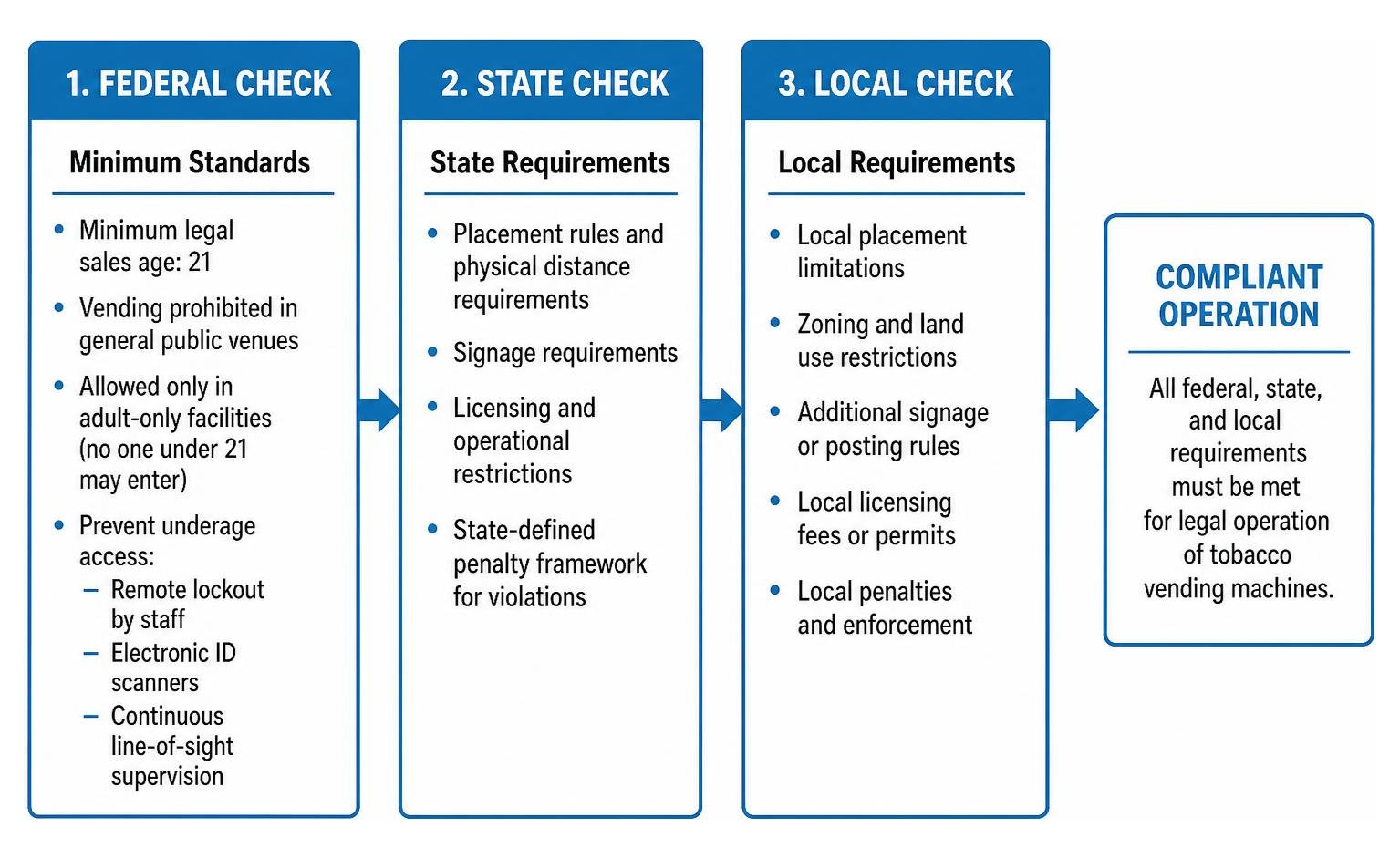
The short answer is yes, but the regulatory environment is heavily restricted. Under federal oversight led by the Food and Drug Administration (FDA) Center for Tobacco Products, automatic dispensers for cigarettes and smokeless tobacco cannot operate in general public venues. When the federal “Tobacco 21” legislation was enacted, raising the minimum legal sales age nationwide from 18 to 21, the operational landscape for self-service tobacco sales shifted permanently.
Federal regulations stipulate that tobacco vending is strictly prohibited unless the unit is located inside an adult-only facility where individuals under 21 years of age are legally barred from entering at all times. Learning the operational realities of tobacco vending machines means understanding that self-service units are no longer the ubiquitous, roadside staples of the 1970s and 1980s. Today, they operate under strict commercial rules designed to eliminate youth access entirely.
Federal Age Verification and Lockout Requirements
To comply with federal guidelines, vending machines cannot operate as uncontrolled mechanical dispensers. In permitted environments, operators must prevent underage access through strict point-of-sale controls. In many settings, this involves:
- Remote supervisory lockout switches: The unit remains electronically locked until an employee behind a counter or bar visually confirms the patron’s identity and activates the machine remotely.
- Integrated electronic ID scanners: Modern units may incorporate automated scanners to validate government-issued identification cards before unlocking product coils.
- Continuous line-of-sight supervision: Even in age-restricted spaces, federal and municipal codes frequently mandate that the physical unit sits directly within the cashier’s or bartender’s uninterrupted field of view.
Allowable Locations and Access Restrictions
Because federal and state laws demand total age segregation, you will only encounter automated tobacco retail in specific commercial footprints. Permitted venues typically include:
- Commercial bars, taverns, and nightclubs that check identification at the front entrance and bar minors from entering.
- Restricted gaming floors and casino lounges where patrons under 21 are legally prohibited from loitering.
- Private, membership-only adult clubs.
If you are exploring how to find modern adult-only venue cigarette machines, you will notice they have vanished entirely from shopping mall corridors, family diners, laundromats, and general office lobbies.
State-Level Placement, Signage, and Penalty Frameworks
Federal standards set the regulatory floor, but state and municipal governments establish the operational ceiling. When addressing whether tobacco dispensers can operate in a specific city, local statutes dictate physical placement, licensing fees, distance rules, and operational penalties.
State Breakdown: Where Are Tobacco Vending Machines Legal?
States regulate automated tobacco sales with varying degrees of restriction:
| Jurisdiction | Primary Statutory Authority | Placement & Physical Distance Rules | Licensing & Operational Restrictions | Non-Compliance Penalties |
|---|---|---|---|---|
| Nevada | Nevada Revised Statutes § 202.2494 on cigarette vending machines | Permitted in 21+ establishments; must be placed at least 10 feet away from any entrance/exit unless an official waiver is granted. | Separate licensing required; written notice of unit moves must be filed 10 days in advance. | Administrative citations, license suspension, or revocation. |
| Georgia | Georgia Code § 16-12-173 vending regulations | Permitted in areas not readily accessible to under-21s (factories closed to public, 21+ bars). | Glass panel must show 3+ packs per column & tax stamps; dedicated route person permits required. | Misdemeanor; fine up to $300 for a first offense; contraband seizure. |
| Michigan | MCL § 750.470 | Banned in public spaces; permitted in Class C licensed bars or private work areas at least 20 feet from public doors. | Direct employee supervision required; strict physical separation from non-licensed rooms. | Misdemeanor; up to $1,000 fine per day, 6 months jail, or 45 days community service. |
| California | Cigarette & Tobacco Products Licensing Act | Adult-only locations; each individual vending machine is legally defined as a separate retail storefront. | Annual retail license required per machine from CDTFA; 4-year invoice retention. | Civil fines up to $5,000 per offense; up to one year imprisonment for unlicensed sales. |
| Maine | Title 22, § 1553-A | Restricted strictly to locations where access is barred to anyone under 21 years of age. | Must dispense tobacco exclusively; cannot mix snacks or sundries; explicit font rules. | Civil forfeiture between $100 and $500; mandatory 6-month machine ban on premises. |
In Nevada, state compliance requires close attention to physical floor plans. Under NRS 202.2494, machines must sit at least ten feet away from any public entryway unless the state licensing body issues an explicit architectural waiver.
Mandatory Signage and Lettering Dimensions
Warning signs are not an afterthought—they are strict statutory requirements. In many jurisdictions, missing or undersized signage is treated with the same severity as selling to an underage patron.
- Exact Statutory Verbiage: In Georgia, for example, the machine must display an unabridged, conspicuous decal stating: “THE PURCHASE OF CIGARETTES, TOBACCO PRODUCTS, TOBACCO RELATED OBJECTS, ALTERNATIVE NICOTINE PRODUCTS, OR VAPOR PRODUCTS FROM THIS VENDING MACHINE BY ANY INDIVIDUAL UNDER 21 YEARS OF AGE IS PROHIBITED BY LAW.”
- Minimum Lettering Heights: In states like Maine, warning labels must meet exact typographic specifications, requiring a minimum lettering height of 3/8 inches.
- Surgeon General Health Warnings: Point-of-sale graphics must clearly show mandatory federal health notices regarding the dangers of nicotine addiction and associated health risks.
Violations, Misdemeanors, and Operational Bans
Violating vending machine statutes carries serious consequences:
- Daily Compounding Fines: Under Michigan law, each separate day a non-compliant machine dispenses tobacco constitutes an independent misdemeanor offense, accumulating fines of up to $1,000 per day alongside possible 6-month jail sentences.
- Premises Operational Bans: Maine authorizes enforcement authorities to prohibit a non-compliant facility from housing any cigarette vending equipment on the property for up to six months following an infraction.
- Contraband Seizure & Forfeiture: Machines stocking untaxed inventory or operating without visible tax stamps can be seized along with their contents by state revenue agents.
Operational Rules: Licensing, Product Limits, and Maintenance
Operating automated tobacco equipment requires substantial administrative upkeep, tax accounting, and route management.
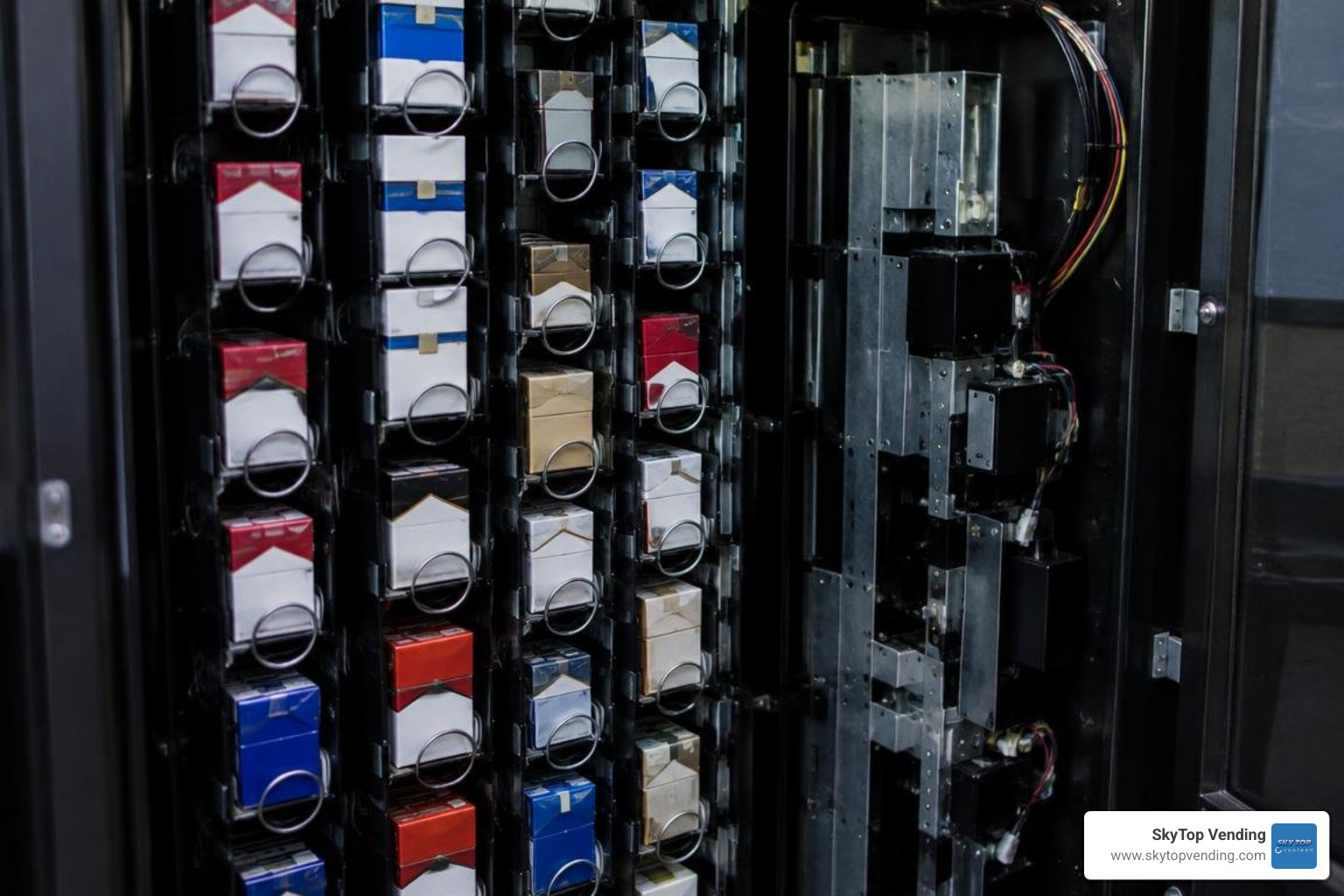
Collectors searching for antique cigarette machines often discover that while vintage mechanical cabinets make great display pieces, placing them into active commercial service requires modernizing them to satisfy current licensing standards.
Product Restrictions and Prohibited Cross-Merchandising
State and federal laws strictly control what products can share space inside a machine:
- Exclusive Dispensing: Most jurisdictions prohibit mixing general snacks, beverages, or confections inside a tobacco unit. A machine designated for tobacco must dispense tobacco products exclusively.
- The Match Exception: In states like Georgia, statutory rules prohibit non-tobacco inventory entirely, with one explicit exception: matchbooks.
- Vapor Product Prohibitions: While e-cigarettes have surged in popularity, several state administrative codes strictly forbid dispensing vapor cartridges, disposables, or e-liquids from mechanical vending units, even within adult-only facilities.
Licensing and Purchase Invoice Recordkeeping
To satisfy both state tax commissions and municipal health boards, operators must follow rigorous recordkeeping procedures:
- Four-Year Invoice Retention: State taxing bodies (such as California’s CDTFA) require operators to maintain complete, legible purchase invoices on file for at least four years to prove product origins and tax payments.
- Individual Machine Permitting: Rather than holding a single master corporate license, operators must register each machine as an independent retail location, conspicuously displaying the permit on the cabinet.
- Permitted Route Staff: Technicians stocking and collecting funds from vending routes must often carry dedicated state route permits issued under oath.
Global Perspectives: Where Are Tobacco Vending Machines Legal or Banned?
International regulatory frameworks show a stark contrast between total prohibitions and technologically advanced compliance models.
The World Health Organization Framework Convention on Tobacco Control (WHO FCTC) Article 13 recommends that member nations ban tobacco vending machines outright because they can act as point-of-sale marketing and facilitate youth access.
- Total International Bans: Countries such as the United Kingdom, France, Singapore, Australia, New Zealand, Thailand, Israel, and the Netherlands have completely banned cigarette vending machines. Under the UK Tobacco and Vapes Act vending machine ban, it is an offense to maintain any vending machine selling tobacco, herbal smoking items, or nicotine pouches, carrying fines up to £2,500 in England, Wales, and Scotland, and up to £5,000 in Northern Ireland.
- Technological Compliance Models: Germany maintains a large global footprint of outdoor and indoor cigarette dispensers, relying on electronic age verification via European debit cards and national IDs. Japan uses the government-registered “Taspo” smart-card system and digital age-verification hardware to restrict automated sales to adults.
Frequently Asked Questions About Tobacco Vending Compliance
Can a tobacco vending machine sell electronic cigarettes or non-nicotine vapes?
In most jurisdictions, no. While the FDA classifies e-cigarettes as deemed tobacco products, several state revenue and administrative codes prohibit the sale of liquid vapor devices and alternative nicotine hardware through self-service vending machines. Even 0mg non-nicotine liquids often require specialized retail licensing and face similar placement barriers.
What are the physical distance requirements between a vending machine and facility entrances?
Distance mandates vary by state statute. For example, under Nevada Administrative Code guidelines, machines operating in age-appropriate venues must be placed at least ten feet away from any facility entrance or exit unless a formal architectural waiver is granted. In Michigan, machines located in private, non-public industrial workspaces must maintain a 20-foot buffer from public entry doors.
Who is legally liable if a minor buys tobacco from a vending machine?
Both the property manager/licensee and the route operator can be held legally liable. Violations result in joint enforcement actions, including misdemeanor charges for premises staff, civil forfeitures, forfeiture of vending inventory, and administrative license revocations.
Conclusion
Understanding the rules governing automated tobacco retail requires navigating a complex mix of federal “Tobacco 21” mandates, state-level distance restrictions, explicit signage rules, and comprehensive tax licensing. Operating within the law demands strict placement in adult-only venues and continuous verification controls.
At SkyTop Vending, we have delivered professional breakroom and facility solutions across the Las Vegas Valley since 1977. Backed by our 99.4% client retention rate and our guiding philosophy—”Service the way YOU like it”—we help business owners navigate equipment options safely and effectively.
If you want to upgrade your property with fully compliant snack, beverage, micro-market, or office coffee systems, explore our compliant commercial breakroom and vending solutions in Las Vegas to create a convenient, hassle-free refreshment program for your team and guests.