
Why Employee Happiness Is Your Business’s Most Overlooked Advantage
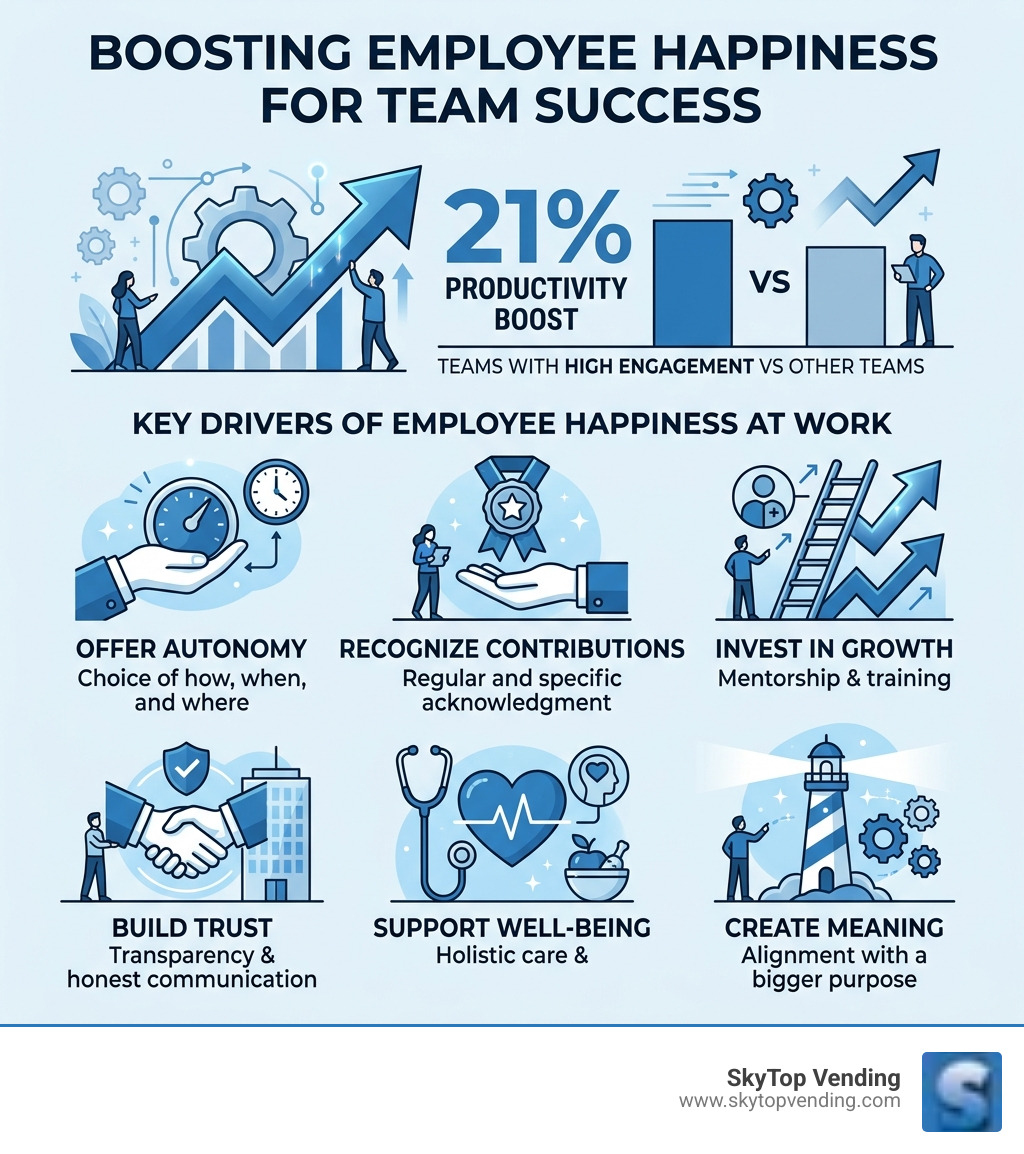
Boost employee happiness with these proven, practical strategies:
- Offer autonomy — let people choose how, when, and where they work
- Recognize contributions — regularly and specifically, not just once a year
- Invest in growth — mentorship, training, and clear career paths
- Build trust — through transparency, honest communication, and open-door leadership
- Support well-being — mental health resources, healthy food options, and social connection
- Create meaning — help people see how their work connects to something bigger
Think about the last time you had a truly great experience with a business. Chances are, the person helping you seemed genuinely happy to be there.
Now think about the opposite. An employee who looks like they’d rather be anywhere else. That energy is contagious — and it flows straight to your customers.
Here’s the thing: most employees aren’t happy at work right now. Only 32% of U.S. workers report feeling engaged — a decade low. And the average person spends around 90,000 hours of their life at work. That’s a long time to feel disconnected.
The “quiet quitting” movement put a name to something managers had been sensing for years. People weren’t leaving their jobs. They were leaving mentally — doing the bare minimum while physically staying put. And it’s costing businesses in productivity, retention, and culture.
But here’s the good news: happiness at work isn’t a mystery. It’s not just about ping-pong tables or free pizza Fridays. It’s about feeling valued, trusted, and like your work actually matters.
88% of employees say a healthy workplace culture is key to success. And teams with high engagement are 21% more productive than those without it. The return on investing in your people is real — and measurable.
The Science of Workplace Satisfaction
To truly boost employee happiness, we have to look past the surface level. It isn’t just a “nice-to-have” vibe; it is rooted in positive psychology. Martin Seligman, often called the father of positive psychology, shifted the focus from what’s “wrong” with people to what makes life worth living. In the workplace, this translates to creating an environment where people can reach a “flow state”—that magical zone where you’re so absorbed in meaningful work that time seems to disappear.
When we prioritize using care to unlock employee happiness and health, we tap into the “service-profit chain.” This theory proves that internal service quality (how we treat our team) drives employee satisfaction, which in turn drives productivity and customer loyalty. If our team in the Las Vegas Valley is happy, our clients are happy. It’s that simple.
Happiness at work is characterized by emotional commitment. It’s the difference between someone who logs in just to collect a paycheck and someone who stays an extra ten minutes to ensure a client’s problem is fully resolved because they actually care about the outcome.
Using the PERMA Model to boost employee happiness
One of the most effective frameworks for understanding workplace satisfaction is Seligman’s PERMA model. By focusing on these five pillars, leaders can systematically improve the daily lives of their staff:
- Positive Emotions: This isn’t about being “happy-clappy” all the time. It’s about fostering gratitude, hope, and interest. A simple “thank you” email or a public shout-out can trigger these emotions.
- Engagement: Help employees find their “flow.” This happens when their unique strengths are matched with the right challenges. When people use their top talents daily, they are significantly more productive and less likely to experience depression.
- Relationships: We are social creatures. Strong work relationships are often more powerful for well-being than the work itself. Creating spaces for genuine connection—like a shared breakroom area—is vital.
- Meaning: People want to know their work matters. Leaders should regularly articulate the company’s values and share success stories that highlight the positive impact the business has on the community.
- Accomplishment: We all need a “win.” Setting SMART goals (Specific, Measurable, Achievable, Relevant, and Time-bound) gives employees a clear path to success and a sense of pride when they hit those milestones.
5 Practical Strategies to boost employee happiness Today
You don’t need a massive HR budget to make a difference. Many of the most effective ways to boost employee happiness are low-cost or even free.

1. Embrace Autonomy and Flexibility
The “command and control” style of management is dead. Today’s workforce craves autonomy. This means giving employees a say in how they complete their tasks, setting their own schedules where possible, or offering hybrid work options. When people feel trusted to manage their own time and processes, their stress levels drop and their loyalty to the company rises.
2. Prioritize Recognition and Rewards
A little appreciation goes a long way. In fact, 51% of employees say recognition from their manager is a top driver of morale. This can be as simple as a handwritten note or as structured as a peer-to-peer recognition program where colleagues can nominate each other for “wins.” Check out these Employee Engagement Ideas To Keep Your Staff Happy for more inspiration on building a culture of appreciation.
3. Invest in Professional Development
If you don’t help your employees grow, they’ll find someone who will. Continuous training signals that you value their future, not just their current output. This could include workshops, online courses, or mentorship programs that pair junior staff with senior leaders. When employees see a clear career path, they are much more likely to stay for the long haul.
4. Foster Social Connection
Work shouldn’t just be about tasks; it should be about people. Organize team-building activities that aren’t cringeworthy—think local volunteer events, casual lunches, or even a quick scavenger hunt. These moments build the “social capital” that makes collaboration easier when things get stressful.
5. Upgrade the Daily Experience
Small daily perks can have a massive cumulative effect. Think about the beverages and snacks available in your office. Are they inspiring, or are they an afterthought? Finding an Office Beverage Provider That Your Employees Will Actually Love is a simple way to show your team that you care about their comfort and daily needs.
Leadership and Culture: The Foundation of Morale
We’ve all heard the saying: “People don’t quit jobs; they quit managers.” Research backs this up, showing that managers account for a staggering 70% of the variance in team engagement. If you want to boost employee happiness, you have to start with leadership.
Transparency and trust are the bedrock of a healthy culture. When leaders are open about the company’s successes and its mistakes, it prevents the rumor mill from churning and makes employees feel like true partners in the mission. An open-door policy isn’t just a phrase; it’s a commitment to listening to feedback and—more importantly—acting on it.
Middle managers are often the unhappiest group in an organization. They are squeezed between executive demands and team needs. Supporting these leaders with coaching and feedback loops is essential. When managers are equipped to be coaches rather than “bosses,” they can create personalized career growth plans for their team members, which is a major driver of retention.
We also know that the environment plays a huge role in how people feel. The Secret Sauce to Perfect Office Pantry Management involves more than just stocking shelves; it’s about creating a hub where people feel nourished and valued. A culture of recognition starts at the top and trickles down into every interaction.
Creating a Physical Environment for Well-being
In the Las Vegas Valley, where business moves fast and the climate can be intense, the physical office environment is a sanctuary. To boost employee happiness, we must design spaces that prevent burnout and encourage mental health breaks.
The Power of the Micro Market
Gone are the days of the lonely, clunky vending machine in a dark corner. Modern Micro Markets in Las Vegas offer fresh salads, sandwiches, fruit, and yogurt in an open-market setting. This allows employees to grab a healthy meal without having to leave the building, saving them time and reducing mid-day stress.
Hydration and Healthy Snacks
Hydration stations and premium coffee services aren’t just perks; they are productivity tools. Providing high-quality water and low-sugar snack options shows employees that their health is a priority. When you go Beyond the Breakroom: Elevating Your Office with a Top-Tier Pantry Service, you transform a utility into an experience that boosts office morale.
Dedicated Social Spaces
A breakroom should be more than a place to microwave leftovers. It should be a team-building space. Comfortable seating, natural light, and even amusement games can provide the mental “reset” employees need to return to their desks focused and refreshed. By investing in these physical touchpoints, you send a clear message: “We value your well-being.”
Frequently Asked Questions about Employee Satisfaction
How can I boost employee happiness without giving raises?
While fair pay is the baseline, money doesn’t buy long-term engagement. You can boost employee happiness without raises by offering:
- Autonomy: Give them control over their work environment and schedule.
- Recognition: Implement regular, specific praise and peer-to-peer awards.
- Flexibility: Allow for hybrid work or flexible start/end times.
- Meaningful Work: Connect their daily tasks to the company’s larger purpose.
- Professional Growth: Offer training and mentorship opportunities.
- Low-cost perks: Things like a well-stocked pantry or a better coffee service make a huge daily difference.
What are the main causes of employee unhappiness?
According to research, the top drivers of dissatisfaction are:
- Poor Leadership: Managers who micromanage or fail to provide support.
- Lack of Growth: Feeling “stuck” in a role with no future.
- Unfair Treatment: Favoritism or lack of transparency in decision-making.
- Overwork: Consistently high workloads that lead to burnout.
- Disconnection: Not understanding how their work contributes to anything meaningful.
How do you measure the success of happiness initiatives?
You can’t manage what you don’t measure. Use these tools to track your progress:
- Gallup Q12: A science-backed survey that measures 12 key elements of engagement.
- Pulse Surveys: Short, frequent check-ins to gauge the “mood” of the office.
- Retention Rates: If people are staying longer, your initiatives are likely working.
- Absenteeism: Happy employees show up more often. Highly engaged teams see a 41% reduction in absenteeism.
- eNPS (Employee Net Promoter Score): Simply ask: “On a scale of 0-10, how likely are you to recommend this company as a place to work?”
Conclusion
At the end of the day, boosting employee happiness is about treating people like people, not just “resources.” It’s about creating an environment where they feel safe, valued, and energized. Whether it’s through better leadership, more autonomy, or simply providing a better breakroom experience, the effort you put into your team will always return to you in the form of loyalty and productivity.
At SkyTop Vending, we’ve seen this firsthand. Serving the Las Vegas Valley since 1977, we’ve maintained a 99.4% client retention rate by focusing on “Service the way YOU like it.” We know that a vibrant breakroom—complete with fresh food, great coffee, and even Amusement Equipment in Las Vegas—is often the heart of a happy company culture.
Investing in your team’s happiness is the ultimate “secret sauce” for long-term business success. When your employees thrive, your business follows.