
Fresh Food Vending Is Changing How People Eat at Work
Fresh food vending is one of the fastest-growing shifts in workplace dining — and if you manage a facility or run a business, it’s worth understanding quickly.
Here’s the short answer:
- What it is: Refrigerated, automated machines that dispense real meals — salads, sandwiches, bowls, breakfast items — kept cold and fresh around the clock
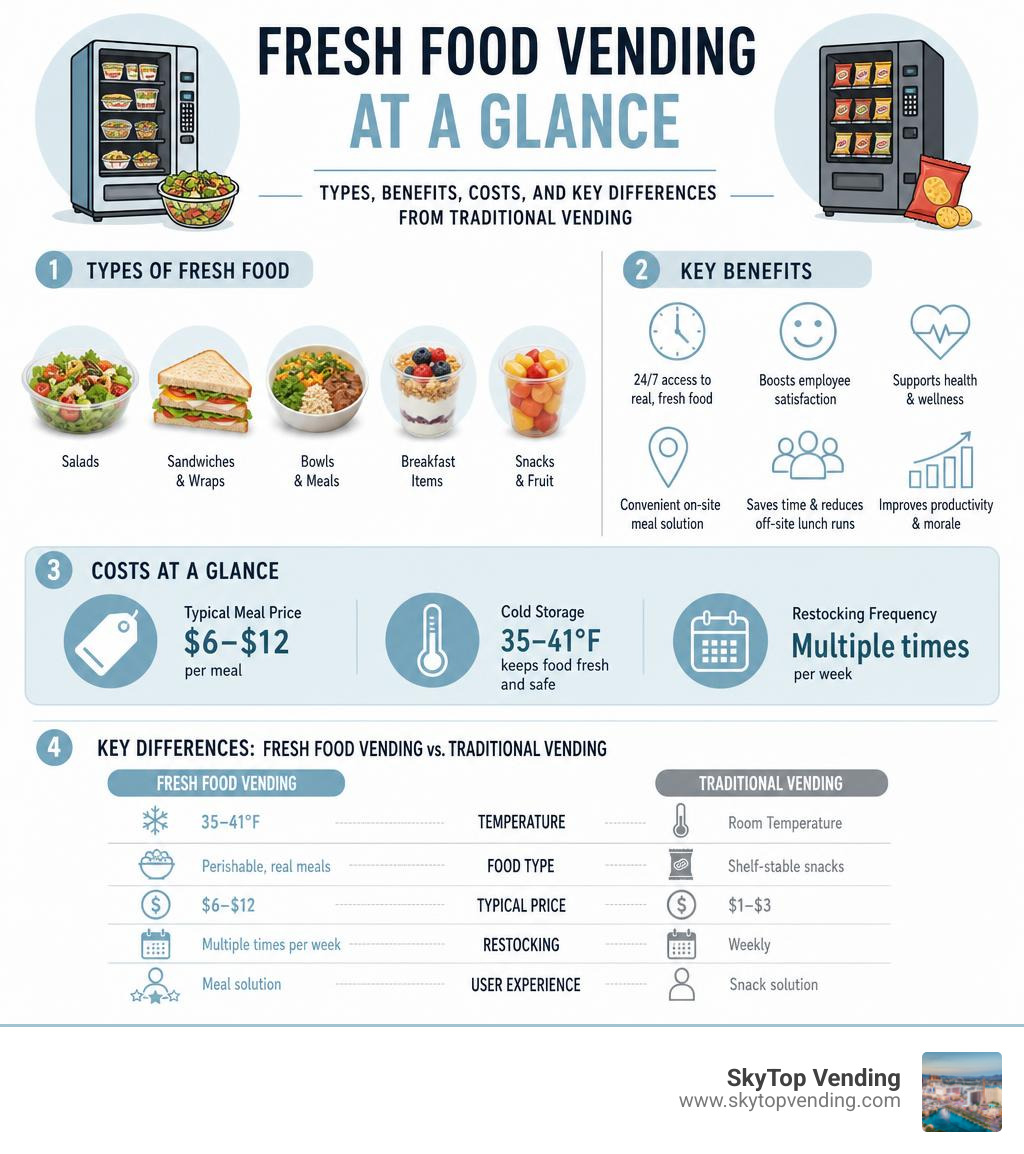
- How it differs from traditional vending: Fresh food machines store perishable items at 35–41°F, offer $6–$12 meal purchases, and require restocking several times per week (vs. shelf-stable snacks restocked weekly)
- Who it’s for: Offices, hospitals, universities, manufacturing plants, airports — anywhere people need a real meal and a cafeteria isn’t always open
- Why it matters now: Employees expect more than chips and candy bars. Fresh, convenient food on-site boosts morale, reduces time lost to off-site lunch runs, and supports wellness goals
For decades, the office vending machine meant one thing: a spiral coil dropping a bag of pretzels into a metal tray. It worked fine when “good enough” was the standard.
But employee expectations have changed. People want real food — not just a snack to get through the afternoon. Night-shift nurses need a meal at 2 a.m. Factory workers on a 20-minute break can’t drive to a restaurant. Students studying late need something more than a candy bar.
Fresh food vending fills that gap. It’s not a minor upgrade to the old snack machine — it’s a fundamentally different approach to on-site food service. And for facility managers and business owners, it represents a meaningful opportunity to improve the daily experience for everyone in your building.
This guide covers everything you need to know: how the technology works, what it costs, where it performs best, and what to watch out for before you commit.
What Is Fresh Food Vending and Why It’s Different
At its core, fresh food vending is an automated retail solution designed specifically for cold-chain storage and the distribution of perishable meals. Unlike traditional setups that rely on shelf-stable ingredients with expiration dates measured in years, these machines function as micro-cafeterias. They are engineered to keep real, minimally processed food fresh, safe, and easily accessible 24/7.
In a environment, having direct access to workplace foodservice is a game-changer. Employees no longer have to choose between a sad bag of potato chips or a 30-minute round-trip drive to the nearest fast-food joint. Instead, they can grab a restaurant-quality meal in under a minute without ever leaving the building.
Fresh food vending vs. traditional vending
The differences between these two formats go far beyond the temperature setting. Traditional vending was built for sweet, salty, and highly processed snacks. It is a low-touch, low-maintenance model. Fresh food vending, on the other hand, is a premium, high-turnover service that operates much like a high-end grab-and-go deli.
The financial metrics highlight this shift. While traditional machines see average transactions of $1.50 to $3.00, fresh food vending machines routinely generate average transaction values of $6.00 to $12.00 per purchase. This higher value reflects the shift from impulse snacking to intentional meal replacement.
Because the inventory is perishable, these machines require a much more rigorous operational model. Instead of a bi-weekly or weekly refill of sodas and chips, fresh food systems require restocking several times weekly—and in high-volume locations, daily replenishment is necessary to keep up with demand and guarantee absolute freshness.
| Feature | Traditional Vending | Fresh Food Vending |
|---|---|---|
| Product Types | Chips, candy, sodas, shelf-stable pastries | Salads, sandwiches, wraps, bowls, yogurts, fresh juices |
| Storage Temp | Ambient or basic cooling (around 50-65°F) | Precise refrigeration (35-41°F / 2-5°C) |
| Average Ticket | $1.50 – $3.00 | $6.00 – $12.00 |
| Restock Frequency | Weekly to bi-weekly | Daily to 3x weekly |
| Shelf Life | 6 to 12 months | 2 to 7 days |
| Primary Use Case | Quick snack, energy boost | Meal replacement (breakfast, lunch, dinner) |
Where refrigerated meal machines fit in the breakroom ecosystem
Modern breakrooms are no longer a collection of mismatched appliances. They are carefully curated spaces designed to boost employee wellness and retention. Refrigerated meal machines serve as the perfect bridge between basic snack setups and full-scale corporate cafeterias.
For smaller offices or facilities with limited square footage, a single smart fresh food machine offers a complete dining solution without taking up valuable floor space. For larger complexes in the Las Vegas Valley, these machines work beautifully alongside other services. You can easily pair a refrigerated meal unit with high-quality office coffee, water filtration systems, and traditional snack machines to create a hybrid breakroom.
If you have the space and a larger headcount, you might even scale up to a self-service market. Check out our Las Vegas vending machine options and explore how they integrate with larger Las Vegas micro market options to create the ultimate employee retreat.
Technologies, Machine Types, and Product Options

The rapid growth of the fresh food vending industry is fueled by incredible leaps in technology. The clunky, mechanical coin-drop machines of the past have been replaced by sleek, AI-powered smart fridges and high-tech elevator systems.
Smart technology for fresh food vending
The most significant technological breakthrough in automated retail is the rise of the Smart Fridge. Unlike traditional machines where you pay first and hope the mechanical coil drops your item, a smart fridge reverses the process:
- Tap & Unlock: The customer taps a credit card, mobile wallet, or employee badge to unlock the secure glass door.
- Browse & Select: The customer opens the door and can physically pick up items, read nutrition labels, and check ingredients—just like opening their fridge at home.
- Grab & Go: Once the door closes, the machine automatically detects which items were removed and charges the customer’s card instantly.
This seamless experience is powered by two main technologies: RFID (Radio Frequency Identification) and AI-powered sensor fusion. With RFID, every individual meal is tagged with a smart sticker containing its unique product ID, price, and exact expiration date. Internal antennas read the shelf inventory in real-time.
Alternatively, AI-powered systems use high-definition cameras and weight sensors on each shelf to track customer selections. Both technologies allow for remote inventory tracking via cloud dashboards, automatic lockouts of expired products, and robust theft prevention. To learn more about how these modern systems operate behind the screen, check out our guide on smart vending technology.
Elevator, pusher, and refrigerated vending systems
Not every location is suited for an open-door smart fridge. For high-traffic public spaces where maximum security is required, closed-front automated machines are still the gold standard. However, dropping a delicate, hand-crafted salad bowl or glass jar from a top-shelf spiral coil would result in an absolute mess.
To solve this, advanced refrigerated systems use XY-axis elevator systems. When a customer makes a purchase on the touchscreen, a padded elevator platform glides smoothly up to the correct shelf. A gentle pusher mechanism slides the meal onto the platform, and the elevator descends to deliver the product safely to the pick-up slot.
These machines feature double-layered tempered glass with electric heating defrost systems to prevent condensation, ensuring maximum product visibility while maintaining strict temperature zones with constant, balanced air circulation.
Fresh meal and snack categories that sell best
What actually goes inside these high-tech systems? The sky is the limit, but the most successful programs focus on fresh, nutrient-dense, and highly appealing meal options. Nationwide pioneers in this space, such as the Farmer’s Fridge network—which has served over 25 million meals across more than 2,000 locations—have proven that consumers will happily buy fresh meals from a machine if the quality is outstanding.
The best-selling categories include:
- Artisanal Salads & Grain Bowls: Chopped greens, quinoa bowls, and protein-packed salads served with chef-crafted dressings.
- Gourmet Sandwiches & Wraps: Turkey club on brioche, chicken Caesar wraps, and pressed paninis.
- Hearty Breakfast Items: Overnight oats, chia seed puddings, breakfast burritos, and fresh fruit cups.
- Microwaveable Hot Meals: Enchiladas, pasta bowls, and teriyaki chicken that employees can quickly heat up in the breakroom.
- Dietary-Specific Snacks: Gluten-free protein boxes, vegan desserts, kosher items, and organic dairy products.
Freshness, Food Safety, Inventory, and Payments

When dealing with fresh, perishable food, there is absolutely zero room for error. Keeping employees safe and ensuring every meal tastes like it was prepared this morning requires strict operational standards and robust safety protocols.
How freshness and food safety are maintained
Food safety in fresh food vending relies on maintaining an unbroken cold chain from the preparation kitchen to the moment the customer takes their first bite.
- Precise Temperature Control: Machines are equipped with commercial-grade compressors that maintain internal temperatures strictly between 35°F and 41°F (1.6°C to 5°C).
- Automated Health Locks: If a power outage occurs and the internal temperature rises above 41°F for more than a few minutes, the machine automatically triggers a physical and digital lock. It will refuse to dispense any food until a technician inspects the unit, preventing any risk of foodborne illness.
- Tamper-Evident Packaging: All meals are sealed in compliant, tamper-evident packaging with clear allergen warnings, ingredient lists, and precise expiration dates.
- Smart Expiration Tracking: Operators track individual product expiration windows via cloud-connected dashboards. If a salad is approaching its expiration date, the system can automatically apply a discount to encourage a sale, or lock the item out entirely so it cannot be purchased.
Real-time inventory management and restocking workflows
Managing a fresh food program is a dance of supply and demand. Because shelf life is short (typically 3 to 7 days), operators use advanced forecasting tools to minimize waste while ensuring the machine never sits empty.
Single fresh food vending units typically hold 60 to 120 individual products featuring 20+ unique items, while larger micro market installations can stock 300 to 500+ SKUs by combining refrigerated and non-refrigerated displays.
Cloud-based dashboards monitor sales in real-time, sending alerts when popular items are running low. Restocking workflows are highly efficient: a technician arrives with pre-picked, refrigerated totes, scans the machine’s barcode, rotates older items to the front using First-In, First-Out (FIFO) principles, and adds fresh meals in a process that takes just 15 to 45 minutes per machine.
Payments, user experience, and checkout options
To make buying a healthy meal as frictionless as possible, modern fresh food machines offer incredibly intuitive checkout experiences. Customers are greeted by vibrant, 21.5-inch touchscreens displaying high-definition photos of the food, complete nutritional profiles, and allergen filters.
Payment processing is entirely cashless and lightning-fast. Machines support:
- Major credit and debit cards (Visa, Mastercard, Amex)
- Mobile wallets (Apple Pay, Google Pay, Samsung Pay)
- Contactless QR codes
- Closed-loop employee badge systems (perfect for corporate subsidy programs)
Even if a facility temporarily loses internet connectivity, smart machines can store transaction data locally in a secure, encrypted database and sync automatically once the cellular connection is restored.
Benefits, Use Cases, and ROI Benchmarks for Fresh Food Vending
Why are so many organizations in Las Vegas and beyond upgrading to fresh food vending? The benefits extend far beyond simply feeding hungry people; it is a strategic investment in workplace culture and operational efficiency.
Business and employee benefits
For employees, the biggest benefit is convenience and time. The average lunch break is 30 to 45 minutes. If an employee has to drive off-site, wait in line, eat, and drive back, they are rushed and stressed. Having fresh, restaurant-quality meals available steps from their desks turns lunch back into a relaxing break.
For businesses, it’s a powerful tool for recruitment, retention, and productivity. Offering access to healthy meals shows employees that their wellness is valued. It is also an incredibly cost-effective alternative to a traditional, staffed cafeteria, which requires heavy overhead, kitchen space, and payroll.
Additionally, we can set up subsidized programs where employers pay for a portion of the meals—offering discounted or free fresh food as an incredible workplace perk. If you want to make sure your breakroom choices are supporting your team’s health, check out our thoughts on choosing vending machines that won’t make you regret your life choices.
Best locations and industries
While any workplace can benefit, certain industries see an incredibly high return on investment when installing fresh food vending:
- Hospitals and Healthcare Facilities: Healthcare never sleeps, but cafeterias usually close by 8 p.m. Doctors, nurses, and support staff working the night shift deserve access to fresh, healthy food at 3 a.m.
- Manufacturing and Logistics Centers: Often located in industrial parks far from commercial restaurants, these facilities have large workforces with strict break windows. On-site fresh food keeps operations running smoothly.
- Corporate Offices: High-density office buildings use fresh food solutions to encourage collaboration and keep teams energized throughout the day.
- Higher Education Campuses: Placed in dorm lobbies, libraries, or student centers, these machines provide healthy study fuel 24/7.
When selecting a provider to bring these solutions to life, it helps to know what to look for. Check out The Ultimate Guide to Vending Machine Companies Las Vegas to find the right partner for your local facility.
ROI benchmarks for fresh food vending
From a business perspective, the numbers behind fresh food vending are highly compelling. Depending on the location’s foot traffic and product mix, fresh food vending machines can achieve a monthly revenue potential of $2,700 to $18,000+ per machine.
Even smaller, single-unit smart fridges typically generate steady estimated revenues of $800 to $1,600 per month.
Because of the higher transaction values and strong customer demand, payback periods on the hardware can be incredibly fast. High-traffic locations can see full payback periods on equipment investments in as short as 2.1 months, while lower-traffic locations typically see a comfortable 4 to 6-month payback.
Challenges and Planning Considerations Before You Install
While the benefits are clear, implementing a successful fresh food program requires careful planning. Perishable food is a highly active service, and there are several operational realities you must prepare for.
Operational limitations to plan for
The biggest challenge in fresh food vending is spoilage and waste management. If a machine is stocked with 100 salads and only 40 sell before the expiration date, the operator or business faces “shrink” (lost inventory). This is why choosing a highly reliable partner with advanced demand-forecasting technology is essential.
You must also plan for:
- Consistent Power Access: Refrigerated machines require a dedicated, standard 110V-120V outlet and must remain plugged in 24/7 to maintain the cold chain.
- Strong Cellular or Wi-Fi Signal: Smart fridges and cashless payment systems require constant internet connectivity to authorize transactions and monitor inventory.
- Menu Fatigue: Because employees visit the machine daily, the product mix must be rotated constantly to keep them coming back.
Fresh food program checklist
Before you sign an agreement to install a fresh food machine, run through this quick checklist to ensure your facility is ready:
- [ ] Daily Traffic: Do you have at least 100+ employees or daily visitors on-site to sustain a fresh food program?
- [ ] Power Source: Is there a dedicated electrical outlet within 6 feet of the proposed installation site?
- [ ] Connectivity: Is there a strong cellular signal or accessible guest Wi-Fi in the breakroom?
- [ ] Dietary Needs: Have you surveyed your team to identify vegan, gluten-free, or specific allergen requirements?
- [ ] Subsidy Budget: Do you want to offer the food at retail price, or will your company subsidize a percentage of the meal costs as an employee benefit?
- [ ] Service Expectations: Have you established a clear restocking schedule with your provider to ensure the machine is always filled with fresh items?
Frequently Asked Questions About Refrigerated Meal Machines
How often do refrigerated meal vending machines need restocking?
It depends entirely on your site’s volume, but fresh food machines are typically restocked two to four times per week. In incredibly busy environments like large manufacturing plants or hospital breakrooms, daily restocking is scheduled to ensure maximum availability and absolute freshness.
What temperature should fresh vending food be kept at?
To comply with strict food safety regulations and preserve taste, fresh food machines must maintain a constant internal temperature between 35°F and 41°F (1.6°C to 5°C). Modern machines utilize smart sensors to monitor these temperatures in real-time and will automatically lock down if the temperature rises above safe limits.
Is a micro market better than a single fresh food machine?
It comes down to your space and employee count. A single fresh food machine is ideal for tight spaces or locations with 50 to 150 employees. If you have a larger facility with 150+ employees and want to offer a massive variety of products (up to 500 SKUs, including open-shelf snacks, beverages, and fresh meals), a full micro market is generally the better path.
Conclusion: Choosing the Right Breakroom Food Solution
At SkyTop Vending, we believe that providing high-quality food to your team shouldn’t be a headache. Since 1977, we have been delivering premier breakroom solutions across the Las Vegas Valley. Our philosophy is simple: “Service the way YOU like it.” It’s a commitment to customized care that has earned us an incredible 99.4% client retention rate over nearly five decades.
Whether you are looking to install a single, high-tech smart fridge for fresh meals, set up a vibrant micro market, or upgrade your office coffee and water services, we have the local expertise and passion to make it happen.
Ready to transform your breakroom into an employee paradise? Schedule a Las Vegas breakroom consultation with our team today, and let’s build a customized fresh food program that your employees will love!